Digital presence is crucial in the expansion and development of a business in 2025, and the decision made to go with either an app or a site can result in an enormous difference in customer base, accessibility, and income. As apps are leading the mobile use, web sites are the source of brand discovery and search exposure. This is a detailed illustration, which will assist in choosing what is most suitable to your business.
Whether Want to Choose App or Website for Your Business in 2025
Making the decision to go with an app or a web-based tool in 2025 does not involve taste anymore but rather the other way around – it is about matching digital solutions to your business needs and customer requirements. As 90 percent of mobile time is in apps and 80 percent of people base business credibility on websites, both platforms have unique functions in customer interaction and conversion.
Apps are more engaging, customizable, and local to websites that have access to mass audiences and high SEO performance. What you should base this on is the way your audience views and accesses content, as well as the type of functionality your business must be able to offer.
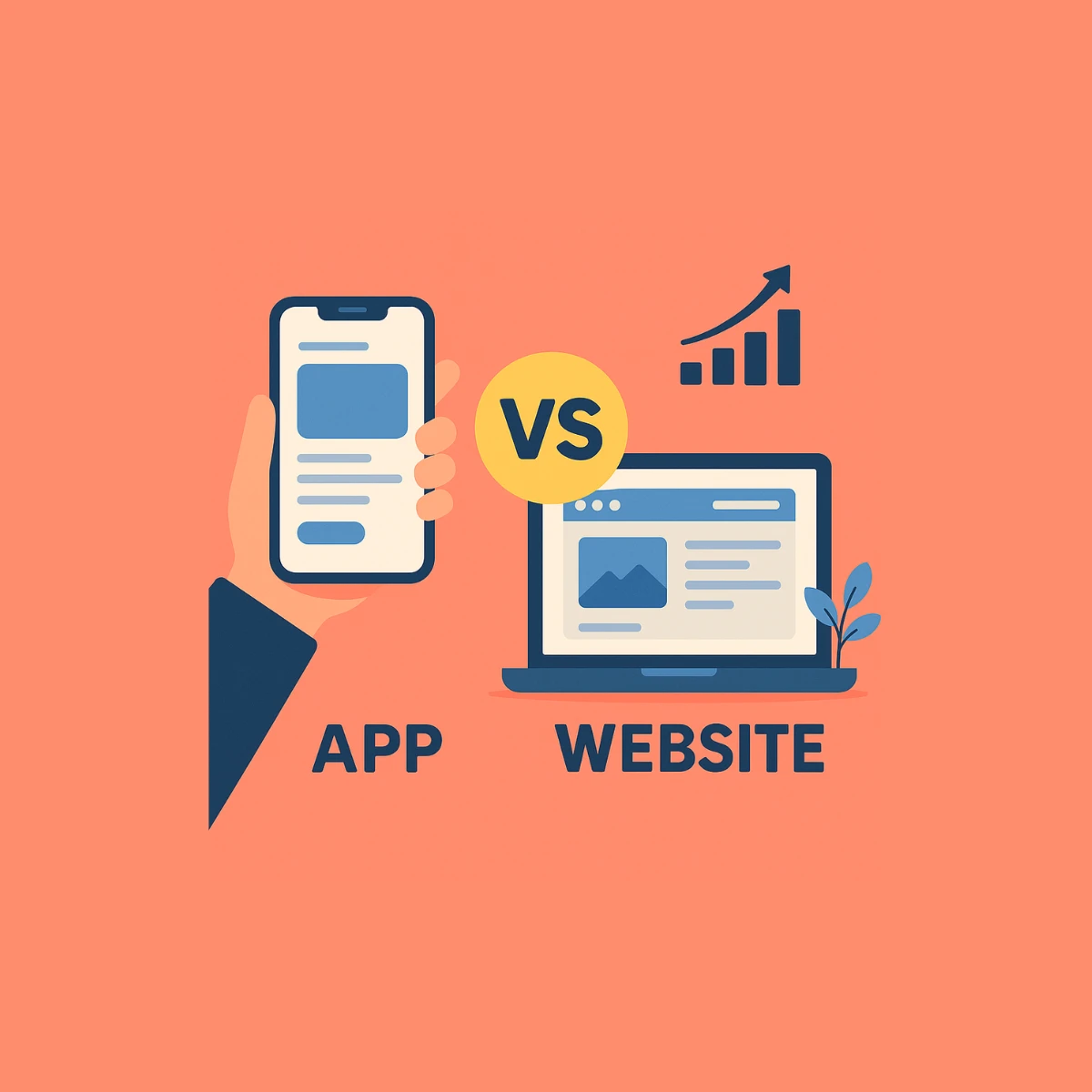
How App Differ from Website (App vs Website)
Knowing about apps and websites distinctions allows better ascertaining the advantages and drawbacks. Despite the fact that both of the platforms can perform business operations, their operability, technology framework, and user interface differ massively.
Websites are browsed, endorsable of search engine optimization, and cross-platform friendly. On the other hand, apps can be downloaded on devices, and they allow improved performance, offline work, and close integration with smartphone functions. An application is more engaging compared to a web site.
Website Benefits and App Benefits
Both apps and websites bring unique advantages depending on your objectives. The table below explains each benefit to help you evaluate which platform better suits your business in 2025.
Website Benefits and Explanation
| Website Benefits | Explanation |
|---|---|
| Faster to Launch | Websites can go live quickly without app store approvals, reducing time-to-market for new businesses or campaigns. |
| Cheaper | Website development and maintenance generally cost less than mobile apps, making it ideal for businesses with tight budgets. |
| Wider Reach | Accessible globally through any browser, websites do not require installation and can reach anyone with an internet connection. |
| Instant Access via Browsers | Users can visit your website by clicking a link, making it easy to share and distribute across platforms. |
| Fastest Updates | You can update website content instantly without needing user downloads or updates. |
| SEO Visibility | Websites are indexed by search engines and help drive organic traffic through targeted keywords. |
| Sharability | Easy link sharing makes websites ideal for social media, email marketing, and ad campaigns. |
App Benefits and Explanation
| App Benefits | Explanation |
|---|---|
| Higher Engagement | Push notifications, immersive interfaces, and faster load times boost engagement. |
| Offline Access | Apps allow users to access selected content or functions without an internet connection. |
| Push Notifications | Real-time alerts help increase retention and encourage user interaction. |
| Superior User Experience | Apps offer smoother, more responsive experiences tailored for mobile use. |
| Better Device Integration | Access to camera, GPS, Bluetooth, and sensors allows for advanced functionality. |
| Brand Loyalty | Having your app icon on users’ phones keeps your brand top of mind and improves recall. |
Website Disadvantages and App Disadvantages
Despite their strengths, both apps and websites come with limitations. Below is a comparison of common drawbacks to consider.
| Website Disadvantages | App Disadvantages |
|---|---|
| Limited offline functionality | High deployment and maintenance cost |
| Slower performance than apps | Platform-specific coding needed (Android & iOS) |
| Poor user experience | Requires regular updates and bug fixes |
| Limited push notifications | App store approval and distribution challenges |
| No deep device integration | Limited discoverability and no SEO benefit |
App vs Website Small Comparison
This side-by-side view shows how apps and websites compare across key business factors in 2025.
| Criteria | Website | Mobile App |
|---|---|---|
| Reach | Global (via search/social) | Limited to download |
| User Experience | Good on desktop | Excellent on mobile |
| Development Cost | Lower | Higher (especially native apps) |
| Speed & Performance | Moderate | Fast, responsive |
| Engagement | Lower (no notifications) | Higher (push, frequent use) |
| SEO Benefits | Strong | Weak |
| Offline Access | Poor | Good |
| Maintenance | Easier & cheaper | Complex & expensive |
10 Situations Where an App Wins
Apps are not always the default solution, but in these 10 cases, they deliver better performance, usability, and returns.
- You Need High User Engagement Apps support push notifications, in-app messages, and real-time alerts, driving user interactions and repeated visits.
- Offline Functionality is Crucial Apps can provide offline access to content, forms, and data, making them ideal for remote use or poor connectivity areas.
- Superior Mobile Experience is a Priority Apps are built for touchscreens and mobile navigation, offering smoother and faster interactions than mobile websites.
- You Need Deep Device Integration Apps can use GPS, camera, sensors, and other hardware, making them ideal for location tracking, scanning, and more.
- You Want to Build Brand Loyalty A branded app icon on the user’s device boosts brand recognition and encourages repeat engagement.
- You Need Personalized Experiences Apps offer better personalization through login-based access and behavioural analytics to tailor content and offers.
- You are Offering Subscription Services Apps support in-app purchases, subscriptions, and secure billing integrations for recurring revenue models.
- You Want Advanced Features Technologies like AR/VR, gamification, and real-time chat are easier to implement in apps.
- Frequent Use is Expected Daily-use services like banking, fitness, or task management work best when housed within an app.
- You are Targeting Younger, Mobile-First Users Gen Z and Millennials prefer apps to websites due to their speed, convenience, and mobile-first design.
10 Situations Where a Website Wins
Websites still hold strong advantages in areas where accessibility, discoverability, and cost matter most.
- You Need Maximum Reach Websites are universally accessible without installation, helping you reach users across all devices instantly.
- SEO and Organic Search Are Important Websites are searchable via Google, offering long-term traffic from search engines without advertising.
- Budget is Limited: Developing and maintaining a website is more affordable than building a native or hybrid mobile app.
- You Need Fast Launch and Easy Updates: You can launch a website quickly and push updates live without waiting for app store approvals.
- Your Audience is Mostly Desktop or Mixed: Websites perform well on larger screens, making them ideal for professional or research-based audiences.
- You want to educate and Inform: Websites are perfect for publishing blogs, articles, FAQs, and lead magnets to nurture awareness.
- You Want to Be Shareable: Sharing a URL is easier than asking users to download an app, especially on social platforms.
- You Need Lower Barriers to Entry No need for downloading, installing, or registering makes websites easier to explore.
- You’re Running Ad Campaigns Landing pages convert better on websites and are easier to track and optimise.
- You Want to Reach International Markets Fast Websites can be translated, indexed globally, and accessed via any device or browser.
When Both Website and App Needed
In many scenarios, combining both a website and an app delivers maximum value by addressing different parts of the user journey.
- You Want to Maximize Reach and Retention Use a website to attract traffic through SEO and ads, and an app to retain and engage customers with notifications and loyalty features.
- You Offer Both Information and Interaction A website educates and promotes, while the app handles interactions like bookings, transactions, or dashboards.
- You Serve Multiple User Types Real estate, for example, may attract leads via the website and offer post-sale services or agent tools through the app.
- You Need to Cater to Both Casual Visitors and Loyal Users Websites serve new users well, while apps are built for repeat or high-frequency use.
- You Have a Scalable, Long-Term Growth Plan Start with a website to build visibility, then launch an app as your brand grows and user engagement becomes a key focus.
- You Want Full Funnel Marketing Control Websites help generate awareness and leads, while apps focus on conversions and loyalty.
- You Want a Seamless Omnichannel Experience Allow users to start a process on the website and complete it on the app, or vice versa.
- You’re Building a Strong Brand Identity A website creates credibility, while a feature-rich app enhances brand experience and retention.
- You Need Flexibility Across Devices Websites work across all platforms, while apps deliver enhanced features on mobile.
- You Want to Dominate in a Competitive Market Using both platforms ensures broader visibility, user preference, and market competitiveness.
Cost Comparison: App vs Website Development in India (2025)
Here is a detailed cost comparison to help Indian businesses understand the financial aspect of building website vs an app.
| Feature / Factor | Website | Mobile App (Native/Hybrid) |
|---|---|---|
| Development Cost (Basic) | ₹30,000 – ₹1,50,000 | ₹1,00,000 – ₹5,00,000 |
| Development Cost (Advanced) | ₹1,50,000 – ₹5,00,000+ | ₹5,00,000 – ₹20,00,000+ |
| Platform | One version for all platforms | Separate for Android & iOS or single hybrid |
| Design UI/UX | ₹10,000 – ₹50,000 | ₹30,000 – ₹1,00,000+ |
| Backend & API Integration | ₹15,000 – ₹80,000 | ₹50,000 – ₹2,00,000+ |
| Hosting & Domain | ₹2,000 – ₹10,000/year | Not required, but backend hosting needed |
| App Store/Play Store Fees | N/A | $25 one-time (Google), $99/year (Apple) |
| Maintenance (Annual) | ₹10,000 – ₹50,000 | ₹30,000 – ₹1,50,000+ |
| Development Time | 2 – 6 weeks | 6 – 20+ weeks |
| Team Needed | 1–3 people | 3–6 people |
Conclusion: Choose the Right One for Your Business
Choosing between an app and a site, or both should depend on the business goals, audience behaviour and budget. A web site supports visibility, credibility and discoverability, and an application fosters greater engagement, retention and loyalty. The brands that are, in 2025, the most future-ready ones will have both: they will provide its customers with an effortless, omnichannel experience that will match both casual visitors and power users.
Whether you choose a website, a mobile app, or both for your business growth, selecting the right development partner is key. If you’re looking for the best app development company in Gwalior or anywhere in India, choose Emedia Infosoft. With a proven track record, expert team, and client-focused approach, Emedia Infosoft delivers powerful digital solutions tailored to your business needs.